Recent Games

Review: Hitman GO for iPhone and iPad

I don't think it had ever happened to me to be completely blown away by the aesthetics of a game as it happened for Hitman GO by Square Enix when I saw it during the TouchArcade live stream on Twitch.
After playing most of it I'd say that the puzzles are a bit on the easy side, and tend to be repetitive, but I certainly find it enjoyable enough to want to complete it (and wait for new levels to be released).

What makes Hitman GO so visually attractive is the care that has been taken to make it look like a physical board game, to the point that every scenario is depicted as an expansion pack with its own box and figures.
The levels themselves look like dioramas, depicting snapshots of daily life. There is often a cinematic intro, though I think that the swimming pool idea has been a bit abused throughout the game.
You can manually move the camera, but only by a limited amount, and it will snap back to its predetermined position as soon as you lift your finger from the screen. Even if it's only a cosmetical thing, I would surely have appreciated more freedom.

But that's too much talking about the visuals. Let's see what the puzzles are actually about.

You control the black character, your main goal is to avoid (or kill as needed) the enemy characters and reach the exit.
The action is turn based: you make a move, then all enemies make their move at the same time. If you land on a spot occupied by an enemy, you kill him; if they do the opposite, you lose. In the level above, you can see the most basic enemy type: a blue guy that just stands still and looks in a fixed direction. All you have to do is avoid passing on the spot right in front of him.

The more active yellow enemies are soon introduced, which move back and forth along a straight line.
A useful thing to note is that the enemies are totally dumb and will strictly follow their routine regardles of how you move. In particular, in the image above you can just move up and you will kill the yellow guy, even if he's looking at you. This is something that you can rarely do, however, because of parity reasons. Since both you and the enemies move by one step every turn, if the distance between you and an enemy is even (like the top right and bottom left guys in the image above), there's no way for you to land on them during your turn. Therefore, they can kill you but you can't kill them. If the distance is odd (like the top center guy) you can kill them and they can't kill you. Needless to say, the latter case is very uncommon.

There is only one way to invert the parity: using manholes, like in the puzzle below.
The manholes are the two squares on the right. During your turn, you can enter one manhole and exit from another. Since in the level above the distance between the manholes is even, this means that during your turn you move by an even number of steps instead of the usual one, and this inverts the parity. This can allow you to kill enemies that would be impossible to kill otherwise.

As said, the enemy characters are dumb and they will do just one thing, but there is an exception: from time to time you will find objects like stones that you can throw nearby to make a noise. This will alert the enemies close enough to where you threw the object: they will walk there and then resume their routine from there, which might mean patrolling a different area.
There are many more elements, which are introduced gradually throughout the game, including:
  • Ferns that you can hide behind.
  • Locked doors and keys to open them. An interesting side effect of opening a door is that it might affect the patrolling route of some enemies.
  • Disguises. Oddly, when you wear a disguise of one color, you only fool enemies of that color. The other enemies still kill you.
  • Rifles and guns to kill enemies at a distance, but also enemies carrying shields so that firing at them is ineffective!
  • And of course, other kinds of enemies.

Additionally to the primary goal, each level has two secondary goals which vary, but the most common are "get the briefcase" and "finish in less than X moves". Others include "don't kill anyone" and "kill everyone". In some very rare cases you can achieve all goals in a single play, but in most cases the secondary goals are incompatible, so you'll have to play a level twice to get both. You will want to do that, because the achieved goals is used to unlock the additional scenarios.

Currently there are 5 scenarios for a total of more than 60 levels, with more promised for the future.
If you fail to unlock the scenarios through normal play, you can still unlock them using in-app purchases, and you can also buy hints that will reveal the solution of each level.

As said at the beginning, I found the puzzles a bit repetitive and easy. The new elements regularly introduced help to keep the game fresh, but the mechanics don't leave much freedom to the player. The way to the exit is usually pretty obvious, and in many cases all you have to do is move back and forth between two spots waiting for the right time to sneak past an enemy. Even the secondary goals don't add much difficulty. On the plus side, you can surely plan your solution using logic and never feel like you need to move around randomly.

If you are looking for challenging turn-based puzzles, I'd suggest to also look at Niño, but if you're happy with a mild challenge and a stellar presentation, definitely consider this game.


Summary

Nontrivialness★★☆☆☆
Logical Reasoning★★★★★
User Interface★★★★☆
Presentation★★★★★
Loading Time★★★☆☆
Saves Partial Progress✘
Status Bar✘


©2014 Nicola Salmoria. Unauthorized use and/or duplication without express and written permission is strictly prohibited. Excerpts and links may be used, provided that full and clear credit is given to Nicola Salmoria and nontrivialgames.blogspot.com with appropriate and specific direction to the original content.

A Visual Catalog of Threes! Clones

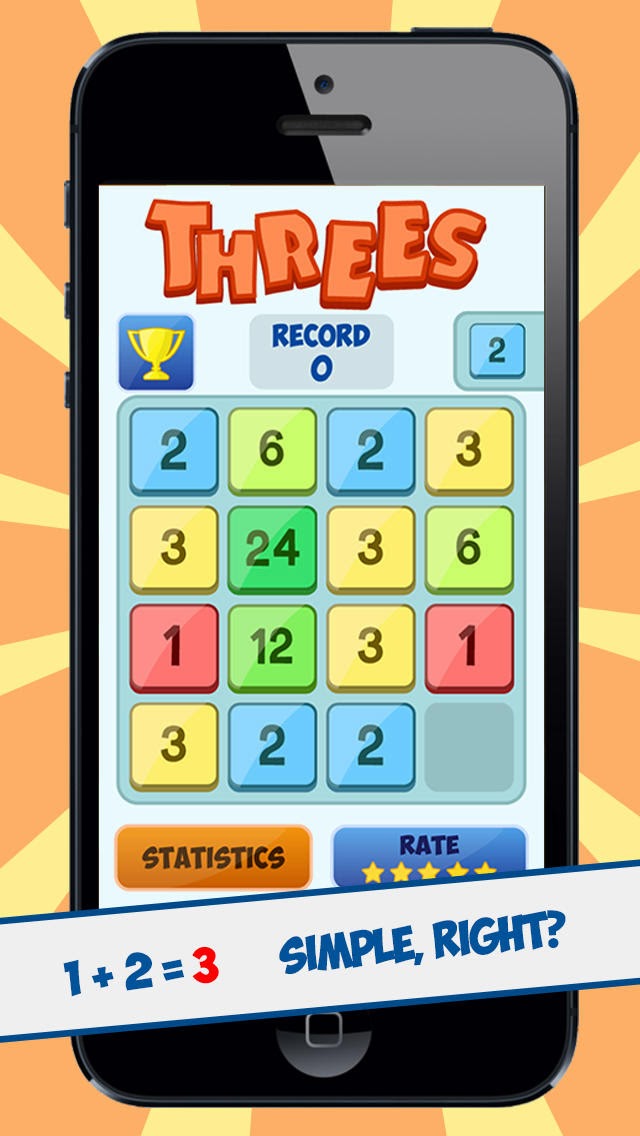
If you follow gaming news, you have probably read about the big drama spurred by the developers of Threes!, who posted a detailed history of the development of their game, to show how long it took them to create it, compared to how quickly it was copied. It's a very interesting read, especially if you are a game designer, so I'd encourage everyone to take a look at it. Threes might look simple, but the process that bought to its final state was far from simple.
Threes!, released February 6th
The one thing I don't like about this story is how all the attention has been put on 2048, calling it a rip-off of Threes. This post was initially going to be about how I don't agree with that, but attempting to prove my point I turned it into a collection of real clones of Threes, so I'll focus on those for now and talk about 2048 another time.

Threes has simple mechanics, so it's easy to imitate. However, it also has excellent production quality, and that isn't easy to copy. Indeed, none of the clones matches the original. Unfortunately this isn't always obvious from the screenshots.

It's also important to note that none of the clones that I have tried faithfully replicate the mechanics. The most obvious difference is where new cards are spawned. In Threes!, new cards only appear at the end of lines that moved. In most of the clones, they can appear on any line, or even anywhere on the board. This changes the gameplay significantly.

The first clone came from China and appeared very soon, though it went largely unnoticed in the US.
聚三成塔 - 数字三消, released February 21st
Nothing happened for a while, then more clones started appearing. Sometimes changing minor things, like replacing 1 and 2 with 3 and 5, which makes absolutely no difference to the mechanics, except that it allows to piggyback on the "powers of 2" trend. The funny thing is that this clone was released before 2048 became #1 on the App Store.
Eights!, released March 12th
Apparently many people like cats, so somebody tried to use them to modify the theme. But the spirit of Captain Triad remained.
Cat Threes, released March 13th
Replacing 1 and 2 with 2 and 3 doesn't change anything either.
Slide Five, released March 18th
Some clones are more boring than others.
Threeswipe, released March 24th
I guess there's nothing wrong attempting to look like a Flash game.
Threes Free, released April 3rd
Many clones imitate the graphics style of Threes, but failing to replicate the quality of the original art.

Some go for a flat look.
Amazing Threes, released March 31st
Others keep an anonymous 3d look.
3366, released April 3rd
The most blatant ripoff to date is probably this one.
Threes Saga, released April 5th
There are ones with more creative graphics too. Doodle style, for example.
Doodle Threes, released April 3rd
Or borrowing from Pudding Monsters.
Monster Threes, released April 4th
Did I miss some? Most likely! But what's clear with all these games is that they copy very closely the mechanics, and often also the art style, of Threes!.

Next time we'll see what instead happened with 2048.


©2014 Nicola Salmoria. Unauthorized use and/or duplication without express and written permission is strictly prohibited. Excerpts and links may be used, provided that full and clear credit is given to Nicola Salmoria and nontrivialgames.blogspot.com with appropriate and specific direction to the original content.

Update: Lazors 2.3

The beautiful Lazors has been updated again, adding a new type of block, the Portal!
The new block does what you would expect from any well behaved portal.

I particularly like what happens when light is reflected back into the portal. As with the Crystal block, the outcomes can be surprising.
You can even create seemingly closed loops... which actually aren't.
Lazors is a great puzzle game that years after its initial release doesn't cease to get better, so if you don't have it on your device yet, make sure to download it now.

The sad note is that on the very same day, somebody released a clone which seems to be little more than a reskin (and even does the same replacing of a S with a Z in the title). No link to that app! I'll just show a screenshot from the App Store description.
Make sure to avoid the copies and only download the original game.


©2014 Nicola Salmoria. Unauthorized use and/or duplication without express and written permission is strictly prohibited. Excerpts and links may be used, provided that full and clear credit is given to Nicola Salmoria and nontrivialgames.blogspot.com with appropriate and specific direction to the original content.

Review: Hard Logic for iPhone and iPad

I'm fond of puzzle games that just throw the players into the action and let them figure out what to do, without lengthy tutorials. Hard Logic by Maxim Urusov surely delivers on that front.
To be honest, I believe that the lack of a tutorial is more due to lack of polish rather than to a deliberate artistic expression, since the game is really bare bones, even lacking a title on the main menu (though it has an "Exit" button which is rarely seen in iOS apps!). Regardless, it worked for me and the first couple of puzzles sucked me in.

The first puzzle seems easy enough. Two empty blocks and a black dot. Your first impulse could be to tap the black dot, but that actually does nothing.
What you have to do instead is tap one of the blocks. The left one, for example; the effect of this is making the other block move over the black dot, and the puzzle is solved.
The machanics become clearer soon enough. When you tap a block, it makes the closest blocks in the same row and column move by one step towards the block you tapped.

But there's a catch! Notice how the two blocks in the bottom left corner, which are side by side, are rendered (very) subtly differently?
Tapping those blocks has no effect: only the blocks that have no immediate neighbors can be used to make a move. This makes sense, because the move should make the neighbors move towards the tapped block, but they are already as close as possible, so there's no place to go.

Of course the ones above were just introductory puzzles, with a single target. Afterwards, in most cases (though not always) you have as many blocks as target cells, so you need to plan your moves accurately in order to bring all blocks to the right place.
Later, some special "twin" blocks are introduced: those are 2x1 rectangles which behave like the normal blocks in all other aspects.
The game contains 120 puzzles, but only the first 26 are free, then you get a request to unlock the full game with a single in-app purchase. The purchase handling is quite buggy and didn't work until I quit the app and launched it again. Everything was ok after that.

I'm on level 48 so far. I didn't encounter any new mechanics and the puzzle size seems to be fixed at the adequate 7x7, but they do get broader and harder, though the number of moves needed to reach the solution fluctuates.
I found the solving process to be quite enjoyable, and I was able to use logic deductions to plan my moves intead of just making random attempts—something which is not that frequent in this kind of puzzles.
It can be useful to work backwards from the ending position: for example in the puzzle above there are three dots one above the other in the left column, so you know for sure that the last move can't be a tap on the top or bottom of those dots: that would form a pair of blocks, leaving the third dot uncovered.

Warning: there is a hint button which tells you exactly what move to make. This could be easily abused to spoil the fun, so try to avoid it. It has a reason to be there because the puzzles must be played in strictly sequential order, though I'd have preferred to simply be able to skip a puzzle you are stuck on instead of spoiling it this way.

As said at the beginning, the user interface of this game is very basic, and the level selection screens are particularly lackluster, but I found the mechanics particularly refreshing, so definitely give it a try.


Summary

Nontrivialness★★★★☆
Logical Reasoning★★★★☆
User Interface★★★☆☆
Presentation★★☆☆☆
Loading Time★★★☆☆
Saves Partial Progress✘
Status Bar✘

©2014 Nicola Salmoria. Unauthorized use and/or duplication without express and written permission is strictly prohibited. Excerpts and links may be used, provided that full and clear credit is given to Nicola Salmoria and nontrivialgames.blogspot.com with appropriate and specific direction to the original content.

Review: Lost Lands for iPhone and iPad

Lost Lands (also free) by Ryan Ding is a seriously challenging maze puzzle that suffered a bit from feature creep but is guaranteed to require all your attention.
The game is entirely based on a single, clever mechanic: L-shaped doors which can only be pushed. This is the same concept as Open Doors and Open Doors 2, two Flash games by Ozzie Mercado (thanks to Keith Harrison for pointing them out to me), but plays quite differently because of the puzzle layout.

Let's see what the doors look like. Here is the first puzzle:
You always start in the top left corner, and need to reach the bottom right (highlighted by a colored gem). In this puzzle, there are just four doors and it's pretty simple. You can just walk all the way to the right, then to the bottom. While passing through the door in the top row, you will push it, so it will rotate clockwise, ending in this position:
Note how every door can be in only one of two positions, because on one side there's a wall, and on the other side there's the doorpost. Understanding how the doors move is by far the hardest thing during the first few levels because, until you learn to distinguish the visual cues, it often looks like you can push a door in a certain direction but you can't.

The fundamental thing to discover is that there are two ways to push a door, which are completely different and have profound effects on solving the puzzles.
The first way is the one seen above, where you push the door from the inside. This move is reversible: you can just walk back through the door, and both you and the door will return to your previous positions.

Soon enough, however, the first kind of move is no longer enough to solve the puzzles. Let's look at another one, and pay attention to the door in the top row:
From this position, you can still walk all the way to the right. In doing so, however, you will push the door from the outside, ending in this position:
Note how this move isn't reversible: now you can walk back left, but the door will not return to its previous position. In a sense, you changed some kind of "parity". You could walk around the top right corner and push the door from the inside, which would return the door to its previous position, but then it would be you that would be on the wrong side of the door.
Pushing doors from the outside, it's actually possible to get stuck into an unwinnable state; luckily, the game kindly informs you when that happens, so you can undo your mistake.

The free version has 168 puzzles in 3 difficulty levels, while the pro version has 480 puzzles in 4 difficulty levels. Interestingly, all the puzzles are played on the same 4x4 grid, with the only thing that changes being the number and position of the doors. The hardest puzzles have 8 doors and look like this:
I found that the best way to solve the puzzles is working backwards from the goal. For example in the puzzle above it's clear that you cannot move the door in the bottom row, because it can only be pushed from the inside, and to do that you would have already reached the gem. Therefore you need to turn the door in the right column, which can only be done by pushing it from the inside: but after doing that, you will be on the wrong side of the door, so you will need to go back to the other side from a different route. Pushing doors from the outside is often the key to prepare an "escape route" to be used after turning some other door. Of course, the harder the puzzles, the more moves you will have to plan in advance.

To move, you simply tap a corner on the same row or column of your man to make him walk. This makes sense because your path can be very convoluted and pass through the same intersection multiple times, so drawing a path wouldn't have worked that well. Your man walk a bit slowly, but you can queue up all the commands needed and then just watch the solution undolf; no need to wait for a move to complete before doing the next.

My main criticism to the game is that it feels overcomplicated. The graphics, while nice, probably make it difficult to clearly understand the mechanics, and the user interface has a bit too many buttons and options, especially in the screen shown after solving a puzzle.

This is certainly not a game for casual players, because understanding its mechanics and taking advantage of them requires discipline. If you feel up to the task (and if you're reading this blog, you should), definitely take a look at it.


Summary

Nontrivialness★★★★★
Logical Reasoning★★★★★
User Interface★★★☆☆
Presentation★★★☆☆
Loading Time★★★★☆
Saves Partial Progress✔
Status Bar✘

©2014 Nicola Salmoria. Unauthorized use and/or duplication without express and written permission is strictly prohibited. Excerpts and links may be used, provided that full and clear credit is given to Nicola Salmoria and nontrivialgames.blogspot.com with appropriate and specific direction to the original content.

Review: Niño for iPhone and iPad

Niño by Lennard Meijer, Reinder Nijhoff, and Peter Kortenhoeven is a nice turn-based strategy game which can be pretty challenging.
The movement rules are simple but they don't get boring because there are many different elements—maybe even too many.

You are the blue cloud. You have to move through the board and reach the exit at the top of the screen without being captured by the red clouds.
The game is turn based, so you make a move, then the red clouds make a move. Your move consists of two steps in any direction, including diagonally and a mix of different directions. The red clouds move by only one step, so they are slower than you, but there are a lot of them.

The mountains and windmill you can see in the picture are the most common elements, at least initially. Mountains are simply obstacles: squares that cannot be visited. Windmills grant you an extra step when you pass over them. Beware! The red clouds can benefit from the same boost, something which will give you many headaches in the later puzzles.

The red cloud movement logic is simple and deterministic, though not explicitly described. They just move towards you, but in some cases there are multiple ways to do so, and learning the exact direction they will take is crucial.

There are many other elements that you get to play with.
Factories destroy any cloud that passes over them. Good if it's a red cloud, but very bad for you.
Weddings will make you lose if any cloud passes over them, so not only you must avoid them, but you must also keep the red clouds away. I think this was a nice humorous touch.
The controls work well after you get used to them. Intuitively, you might want to drag your tile to where you want it to go, but instead you just need to tap the destination square. Dragging does work, but there is no visual feedback and it's occasionally inaccurate, so better not do it.

In some cases you also might not want to move by 2 steps. To end the turn early, just double tap your cloud. This is explained at the very beginning but isn't actually needed for a few levels, so eventually I forgot about it. Then, for no apparent reason, it is explained again in the last puzzle of the first episode—after I would have needed it so many times!

Solving these puzzles is quite fun. The solution always boils down to taking advantage of your higher speed, so you want to make your enemies move in one direction and then whizz past them on the other side. Many puzzles are easily solved that way, but become harder if you want to match the optimal number of moves indicated by the game. In a few cases, however, the puzzles are just hard, even if you take your time. I found this one particularly difficult:
One minor annoyance is that as you need to replay a puzzle multiple times, you'll often make a move and immediately want to restart. This requires two taps instead of one, because the restart button is hidden inside the pause menu. I'd surely have appreciated a restart button on the main screen.

I guess nobody these days can do without teleports. I'm not fond of them in this particular case, but they do introduce an interesting strategic twist as you can either lure the red clouds to one side and then teleport to the other side, or simply make a red cloud enter into the portal to open up your way to the exit. But be aware that the portals often are just decoys, and you don't need to use them at all to solve a puzzle. Also note that portals only work if your move ends on them. If you land on them with your first step, you pass just through them.
My main criticism is that the game throws too many different things at the player in a relatively short time, making it feel a bit messy. This is particularly obvious with the faster clouds, which move two steps at a time. They are introduced in one puzzle and then never seen again for a long time.
Also there are clouds which can pass over factories without being destroyed:
There are also elements that require combined actions. Here you need to first pass over the sea to pick up water, then pass over the thirsty flower. That opens the exit. It's an interesting mechanic, but feels a bit contrieved.
The trickiest element could be the electric grids. You need to get a red cloud over the solar panel at the right time to power off the grid and be able to pass through it.
An uncommon feature is that you play in portrait orientation on iPhone and landscape on iPad. I find the portrait orientation more intuitive.
There's a total of 200 puzzles split in 5 episodes, and they all seem to be available for free, though you need to unlock them in order. There is a single in-app purchase whose only effect seems to be to remove the (somewhat annoying) full screen ads.

Game Center is supported, though only under iOS 7 for some reason, and there is no in-game button to see the leaderboards.

This game is fun and free, so definitely give it a try.


Summary

Nontrivialness★★★★☆
Logical Reasoning★★★★★
User Interface★★★☆☆
Presentation★★★★☆
Loading Time★★★★☆
Saves Partial Progress✘
Status Bar✘

©2014 Nicola Salmoria. Unauthorized use and/or duplication without express and written permission is strictly prohibited. Excerpts and links may be used, provided that full and clear credit is given to Nicola Salmoria and nontrivialgames.blogspot.com with appropriate and specific direction to the original content.
Review: Impuzzible - Monochromatic Rectangles Puzzle for iPhone and iPad

If you want to play hands-on with a complex mathematical problem, look no further than Impuzzible - Monochromatic Rectangles Puzzle.
The stated goal is pretty simple: change the color of the blocks (choosing among four colors) in such a way that there are no rectangles whose four corners have the same color. The grids get increasingly larger, so how far can you go before giving up?

Solving the first 2x2 grid is trivial, and initially everything looks fine and dandy. The game helpfully highlights the rectangles that don't respect the requirements, and you just need to fix them to proceed.
The game can even seem to be too easy, because it looks like you just need to randomly tap the corners of the wrong rectangles to quickly find a solution. Going up to 10x10 took me little effort.
Continuing to go up, however, becomes increasingly difficult. It starts to become common that every time you tap a corner to remove a rectangle, you create a new rectangle of a different color.

Simple logic isn't going to help you here. Finding a solution involves either random tinkering, or very advanced math.

This is a great way to experiment with a NP-complete problem, and see how much its difficulty is increased by each apparently small increase in the size of the grid.

The game description on the App Store is slightly incorrect. It states: "No one knows how far you can go, but the largest grid for which a solution is known is 18 by 18 (level 17)". It has actually been proven in this paper that no solution exists for 19x18, so 18x18 is the maximum.

Finding solutions for the larger grids took a long time. William Gasarch, one of the authors of the paper above, offered a prize in 2009 to whoever found a 17x17 solution. The solution was eventually found in 2012 by Bernd Steinbach and Christian Posthoff, after some very advanced research explained in this paper, and it wasn't just 17x17 but 18x18.

You can learn more about this problem here and here. All very interesting reads.

The challenge is open: how far can a human go, without the help of a computer?


Summary

Nontrivialness★★★★★
Logical Reasoning★☆☆☆☆
User Interface★★★☆☆
Presentation★★☆☆☆
Loading Time★★★★★
Saves Partial Progress✘
Status Bar✘

©2014 Nicola Salmoria. Unauthorized use and/or duplication without express and written permission is strictly prohibited. Excerpts and links may be used, provided that full and clear credit is given to Nicola Salmoria and nontrivialgames.blogspot.com with appropriate and specific direction to the original content.
 
Support : Creating Website | Johny Template | Mas Template
Copyright © 2013. IOS Puzzle Games Review - All Rights Reserved
Template Created by Creating Website Published by Mas Template
Proudly powered by Blogger