Recent Games
Tampilkan postingan dengan label merging. Tampilkan semua postingan

A Visual Catalog of Threes! Clones

If you follow gaming news, you have probably read about the big drama spurred by the developers of Threes!, who posted a detailed history of the development of their game, to show how long it took them to create it, compared to how quickly it was copied. It's a very interesting read, especially if you are a game designer, so I'd encourage everyone to take a look at it. Threes might look simple, but the process that bought to its final state was far from simple.
Threes!, released February 6th
The one thing I don't like about this story is how all the attention has been put on 2048, calling it a rip-off of Threes. This post was initially going to be about how I don't agree with that, but attempting to prove my point I turned it into a collection of real clones of Threes, so I'll focus on those for now and talk about 2048 another time.

Threes has simple mechanics, so it's easy to imitate. However, it also has excellent production quality, and that isn't easy to copy. Indeed, none of the clones matches the original. Unfortunately this isn't always obvious from the screenshots.

It's also important to note that none of the clones that I have tried faithfully replicate the mechanics. The most obvious difference is where new cards are spawned. In Threes!, new cards only appear at the end of lines that moved. In most of the clones, they can appear on any line, or even anywhere on the board. This changes the gameplay significantly.

The first clone came from China and appeared very soon, though it went largely unnoticed in the US.
聚三成塔 - 数字三消, released February 21st
Nothing happened for a while, then more clones started appearing. Sometimes changing minor things, like replacing 1 and 2 with 3 and 5, which makes absolutely no difference to the mechanics, except that it allows to piggyback on the "powers of 2" trend. The funny thing is that this clone was released before 2048 became #1 on the App Store.
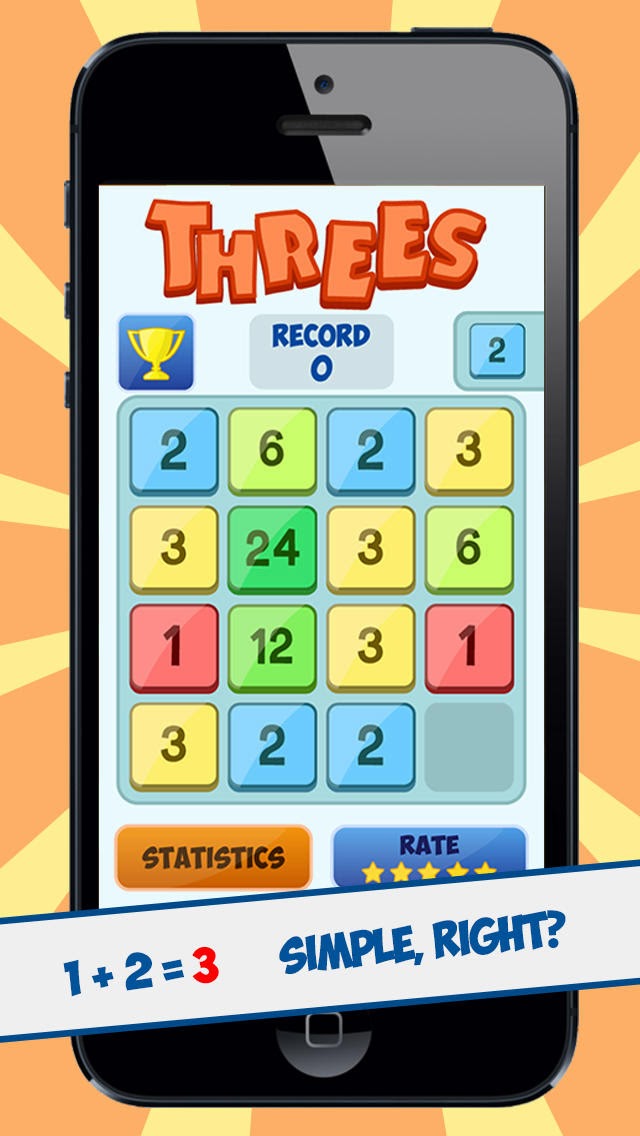
Eights!, released March 12th
Apparently many people like cats, so somebody tried to use them to modify the theme. But the spirit of Captain Triad remained.
Cat Threes, released March 13th
Replacing 1 and 2 with 2 and 3 doesn't change anything either.
Slide Five, released March 18th
Some clones are more boring than others.
Threeswipe, released March 24th
I guess there's nothing wrong attempting to look like a Flash game.
Threes Free, released April 3rd
Many clones imitate the graphics style of Threes, but failing to replicate the quality of the original art.

Some go for a flat look.
Amazing Threes, released March 31st
Others keep an anonymous 3d look.
3366, released April 3rd
The most blatant ripoff to date is probably this one.
Threes Saga, released April 5th
There are ones with more creative graphics too. Doodle style, for example.
Doodle Threes, released April 3rd
Or borrowing from Pudding Monsters.
Monster Threes, released April 4th
Did I miss some? Most likely! But what's clear with all these games is that they copy very closely the mechanics, and often also the art style, of Threes!.

Next time we'll see what instead happened with 2048.


©2014 Nicola Salmoria. Unauthorized use and/or duplication without express and written permission is strictly prohibited. Excerpts and links may be used, provided that full and clear credit is given to Nicola Salmoria and nontrivialgames.blogspot.com with appropriate and specific direction to the original content.

Review: Threes! for iPhone and iPad

People who follow me on Twitter had already seen the heads-up about Threes!, the latest puzzle game by Sirvo LLC.
I wasn't the only one to notice this game, since it quickly climbed to #1 in the App Store charts, proving to be a perfect casual game. But is it also a good game for readers of this blog?

The mechanics are beautifully explained by the official trailer, which is just too good not to repost it here:
You have a 4x4 grid, containing some tiles. All tiles have a number of them.
Your moves consist of just swiping the screen, which makes all tiles move by one step in the same direction. When a tiles reaches the edge of the board, it stops. When pushed against each other, tiles will merge if they are identical (forming a new tile of double value) or if they are 1 and 2, which will produce a 3.
The other thing that happens when you make a move is that a new tile enters the board, at the end of one of the lines that moved. So you must keep merging tiles to make space for the new tiles. When the board is full and you can't make any more merging, it's game over.

The color of the tile you'll get next is shown at top of the screen, so you know for sure if it's a 1 or 2, but if it's white it could be anything, though it will usually be a 3.
In general, you also don't know for sure the exact line where the tile will be inserted, unless all lines but one are blocked.

Note that since all the tiles you merge remain on the board, the value of the tiles keeps increasing during the game, so after a typical game you'd be in a situation like this:

If you play well, 384 is the number you should be aiming to reach frequently. So far, a few people have managed to make a 768, but nobody has yet reached 1536 (apart from one person that hacked the game). The maximum tile available in the game is 6144. I don't think anybody will see it anytime soon. It would take 2048 3's to make one 6144.
The value of the highest tile is important because the score you get at the end of the game grows exponentially with the tile value, so one 384 is worth more than two 192 and so on.

Even if the mechanics are significantly different, I can't avoid comparing Threes! to Stickets, another excellent game released last year. Both games are played on a small board, and alternate moments of increasing tension, as the board fills up, with moments of relief, when you make a streak of matches and free up a lot of space.

More than the pure mechanics, I think there are two important differences between the two games:
  • Stickets is an infinite game. If you don't make mistakes, a game can last forever. Threes!, instead, is inherently finite, because the numbers keep increasing and you reach point where there just isn't enough space to fit all the tiles needed to make a new merge.
  • Both games have an element of randomness, but in Stickets the player is in total control, because the game gives 4 pieces to choose from and you decide which piece to use and where to put it. In Threes!, you only have limited control on where the new piece will be inserted.
In my opinion, Stickets' lack of a definite end was its limit, because a game could take such a long time that after taking days to finish a game I couldn't find the motivation to start a new one. In Threes!, I have the opposite problem: after losing, it's difficult to resist the urge to start a new game :-)

I don't like, however, the excessive use of randomness, which appears unfair at times. It is particularly infuriating when you have planned your moves to accomodate a white tile, and then you get a 48 instead of the 3 you expected. I think this part of the randomness is uncalled for and I'd hope it to be changed in a future update.

I usually focus on the mechanics and don't talk much about the presentation, but in this case I need to spend a few words to say how good it is. All the tiles have subtle animations and have different personalities, making the game cheerful to play. The graphics might seem simple, but a very interesting article on Polygon shows how much work went into them and how many failed attempts were made before reaching the final result.

For me, the most notable achievement in the presentatin is the sound design. More often than not, I play puzzle games with sound turned off, but not this one. The background music is superb—I've been humming it all day—and the way how the tiles talk to you while you play, each one with its own personality, keeps the game lively.

A word of warning: the game currently doesn't work on 4th Generation iPod, it crashes before even reaching the title screen. Hopefully this will be addressed in a future update.

Apart from that, there is no reason not to buy this game immediately. It will definitely be one of the best games of the year.


Summary

Nontrivialness★★★★★
Logical Reasoning★★★★☆
User Interface★★★★★
Presentation★★★★★
Loading Time★★☆☆☆
Saves Partial Progress✔
Status Bar✘

©2014 Nicola Salmoria. Unauthorized use and/or duplication without express and written permission is strictly prohibited. Excerpts and links may be used, provided that full and clear credit is given to Nicola Salmoria and nontrivialgames.blogspot.com with appropriate and specific direction to the original content.

Review: Exponential Invasion for iPhone and iPad

I'd been keeping an eye on Exponential Invasion, a mathematical puzzle game for iPhone and iPad by Danny Perski, since it was released last year.
The premises looked interesting, but as far as puzzle games on the App Store go, I think the price of $2.99 is too high. The other day it was briefly dropped to $1.99, which I still think is too high, but in the interest of science, I bought it.
The game has a minimalistic, polished interface, which I liked a lot.
Unfortunately, the gameplay isn't equally interesting.

First of all, the Exponential in the name is a lie—there's only addition in this game.
You play on a 5x5 grid, and you control the white numbers. You can move them one step at a time, and when you move a number over another number, they are added together.
When you have a number large enough, you can move over a blue number to "conquer" it. When you do that, both numbers disappear. When you've erased all numbers from the grid, you have won.
Somewhat arbitrarily, you can only move a larger number over a smaller number. The only significant effect that this has, is that you cannot combine two identical numbers. This is rarely an issue.

Some cells are grey, and you can't move over them. So most of the puzzles involve finding the way to move your numbers around the board so that you can merge the right ones.
The white numbers are only barely enough to conquer the blue numbers. E.g. in the puzzle above, the sum of the blue numbers is 22, while the sum of the white numbers is just 24. So you need to be careful about which numbers you merge: if you overshoot, you have to start again.

The later levels have blue numbers in the middle of the grid, separating the white numbers. You need to find out which blue number you can initially conquer, using only white numbers from a single group, so that you can remove it from the board and open up more merging possibilities.
The fundamental issue with these puzzles is that they are just trivial. If you can sum numbers in your head, that's pretty much all you need to solve every one of the levels provided. In a few cases it may take a little longer to find the right combination, but it merely requires enumerating possibilities. It's not challenging, nor much fun.

There is the additional goal of solving each level in the optimal number of moves, but unlike other games I've reviewed in the past, it isn't really rewarding, and doesn't add much to the game.

I think the initial idea is a valid one, and a different set of rules might generate intersting and varied puzzles, but as things stand, I cannot recommend this game.

Summary

Nontrivialness★☆☆☆☆
Logical Reasoning★☆☆☆☆
User Interface★★★☆☆
Presentation★★★★☆
Loading Time★★★★★
Saves Partial Progress✘
Status Bar✘

©2013 Nicola Salmoria. Unauthorized use and/or duplication without express and written permission is strictly prohibited. Excerpts and links may be used, provided that full and clear credit is given to Nicola Salmoria and nontrivialgames.blogspot.com with appropriate and specific direction to the original content.
 
Support : Creating Website | Johny Template | Mas Template
Copyright © 2013. IOS Puzzle Games Review - All Rights Reserved
Template Created by Creating Website Published by Mas Template
Proudly powered by Blogger