Recent Games

Strategy Guide: Cross Blocks

In my review of Cross Blocks I said that to find the solution to the puzzles "some amount of trial and error is probably needed". I have to take that back somewhat, because after finding the right strategy I've become quite good at solving the puzzles on the first attempt.

This is a really good logic puzzle, so I'd like to share my findings.
SPOILER ALERT: don't read past this line if you want to find the strategies yourself.

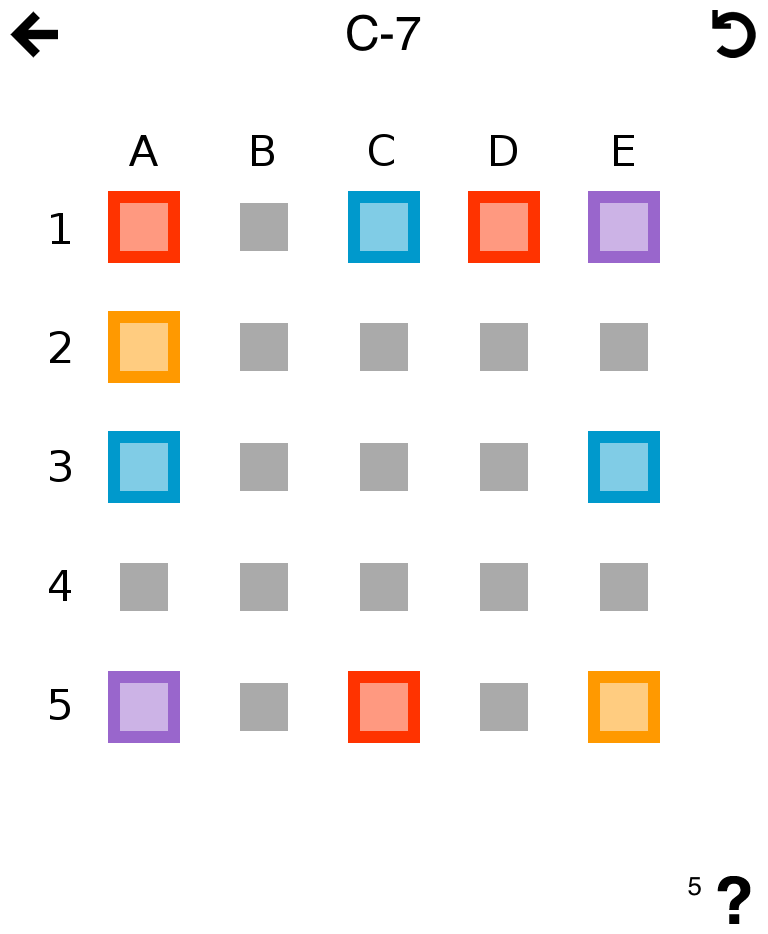
So let's take a look at the above puzzle, where I added coordinates along the edge to make it easier to explain.

The first thing we want to do in any Cross Blocks puzzle is count how many squares there are of each color. When there is an odd number of squares of one color, it means that three of them must be removed at the same time, which limits what we can do with them.

In the puzzle above there are:
3 blue
4 orange
5 red
5 violet

Since there are only 3 blue, there is only one way to remove them: tapping C3. Before being able to do that, we must remove a violet, an orange and a red square.

Let's look at the violets. There are 5, so we have to make one move to remove three of them. Such a move requires two of the squares to be on the same row or colum, so there are two options: E1+E4+C2 and C4+E4+C2.
E1+E4+C2 would require to remove a blue square first. But C2 is one of the squares that prevent that square to be removed, so this move is impossible.
We have to do C4+E4+C2 then, which requires removing two orange squares. It's easy to see that we cannot use the orange square in A2, because it's blocked by the violet in C2 and the blue in A3. Therefore the only way to remove the two orange squares is together, by tapping on C4.
Now we can remove the three violets by tapping on C4 again.
Let's look at the five red squares now. We again have two options for the three-piece move: A1+D1+C5, and A1+A4+D3. Both of them are blocked by a blue square, so we must get rid of the blues first. This is prevented by the red in D3, which implies that we must remove that piece with a two-piece move, so the three-piece move left is A1+D1+C5. The other red square left is A4, so the move we should do now is D3+A4, by tapping on D4.
We can finally remove the blue squares:
Then the red squares:
And now it's trivial to finish.

As I was writing this post, Google+ Auto Awesome thought it was so cool that it collated the images into an animated gif and sent it to me, so I guess I can paste it here :-)


©2013 Nicola Salmoria. Unauthorized use and/or duplication without express and written permission is strictly prohibited. Excerpts and links may be used, provided that full and clear credit is given to Nicola Salmoria and nontrivialgames.blogspot.com with appropriate and specific direction to the original content.

Zen Garden Puzzle: First gameplay video!

Zen Garden Puzzle has been approved by Apple and will be available on the App Store from December 12th!
To whet your appetite, I have prepared a first video to show the game mechanics and interface.


I will talk more about the mechanics in future posts. The one thing I'd like to point out in this video is that the music being played while you drag around the stones is procedurally generated, and different every time you play. I am pleased by the end result. What do you think?


©2013 Nicola Salmoria. Unauthorized use and/or duplication without express and written permission is strictly prohibited. Excerpts and links may be used, provided that full and clear credit is given to Nicola Salmoria and nontrivialgames.blogspot.com with appropriate and specific direction to the original content.

Review: Cross Blocks for iPhone and iPad

Cross Blocks is such a brilliant logic puzzle that I wondered if it had been copied from somewhere else. The developer, Adrenaline Punch Games, had only released word/trivia games before, so a pure logic puzzle like this one is a major shift in focus.
Probably some inspiration for the user interface came from SEQ, but that's all. The mechanics are radically different, and appear to be completely original.

The play area is a board containing some grey and colored squares. Your goal is to remove all the colored squares; you do so by tapping on the grey squares.
When you tap a grey square, its connections in the four main directions are checked. If there are at least two squares of the same color, they are removed.
So in the example above, tapping the grey square at the top would remove the two yellow squares. Tapping the one at the bottom would remove two of the red squares.

But note that there are three red squares in this puzzle, so if you remove two of them you will never be able to remove the single one left. To solve the puzzle, you need to remove all three red squares at the same time.

You can remove two pairs of differently colored squares with a single move. For example, in this puzzle if you tap on the grey square on the second row you will remove two yellow and two red squares. Again, this would be a wrong move because you'd leave a single red square.
Also note that you can't remove two squares that are side by side, like the yellow ones in the third row. There has to be at least one grey square inbetween.

There are other ways to get stuck. For example in this puzzle
if you tap the bottom right grey square, you'll remove two red and two blue squares. This still leaves a pair of each in the top two rows, but they are in such a position that you can't remove the red ones without removing the blue ones first, and you can't remove the blue ones without removing the red ones first.

Logic helps a lot in finding a solution to the puzzles. While some amount of trial and error is probably needed, as it often happens in this kind of games it's useful to think backwards: "I can't remove these pieces until I remove this one, but to remove this one I first need to remove this other one..." From this you get a rough order of removal and just need to fill in the gaps.

If you make a mistake there's an undo button but not a restart button, so to get back to the beginning you need to tap undo multiple times. This is a bit odd but I guess it's ok since you can't make that many moves, even in the larger puzzles.

The game currently contains 120 puzzles, split across 6 worlds of 20 puzzles each. The first 9 puzzles of world A act as a very well thought out tutorial, which seamlessly introduces the rules of the game.
The first two worlds are free, the others can be unlocked through separated in-app purchases, or with a single one to unlock all worlds at a discount.

The puzzles get larger as the worlds progress, with the largest ones being 8x8:
There's also an odd shaped one, but it seems to be an isolated instance all the others I've seen are square.

Very annoyingly, even buying all the worlds doesn't remove the ad banners. This is my number one complaint.

Also, it looks like color blindness hasn't bee taken into account. For example here is a simulation of how a person with protanopia would see the diamond shaped puzzle above:
With its novel mechanics and smooth interface, this is absolutely one of the best puzzle games of 2013. Get it now.


Summary

Nontrivialness★★★☆☆
Logical Reasoning★★★★☆
User Interface★★★★☆
Presentation★★★★☆
Loading Time★★★★★
Saves Partial Progress✘
Status Bar✘

©2013 Nicola Salmoria. Unauthorized use and/or duplication without express and written permission is strictly prohibited. Excerpts and links may be used, provided that full and clear credit is given to Nicola Salmoria and nontrivialgames.blogspot.com with appropriate and specific direction to the original content.

Review: Move: A Brain Shifting Game for iPhone and iPad

I had high hopes in Move: A Brain Shifting Game by the Israelian Nitako.
Initially, the game seemed very fun and addictive. I played through the first 40 puzzles without even realising it. As I moved through the puzzles, however, I felt something was wrong.

But first, let's see the rules. The mechanics are the same as Escapology, stripped to the bare bones by removing the additional clutter of arrows and magnets. Therefore, all we have is a board with some discs, which can move, and gray blocks, which don't move.
When you swipe over the board, all discs that aren't blocked move in the same direction. The goal is to bring all pawns over the colored squares. In the example above, there is only one color, but there can be as many as the number of discs.

The puzzles are divided into packs of 100 puzzles each. The first three packs are free; for the others, you can try the first 10 puzzles and have to buy the rest.

Looking at the pack list, my opinion is that they have been assembled with too strict rules. Every pack contains puzzles of only one kind, e.g. "4x4 board, 4 pawns, 2 colors", which makes them quite boring. Instead of making 12 packs of identical puzzles to cover all combinations, it might have made more sense to provide less packs, with a mix of puzzle types in each pack.
The choice of puzzles is indeed the major flaw of this game. After playing for a while, it becomes obvious that the puzzles have been randomly generated and roughly sorted by the optimal number of moves needed to solve them, but without any attention to their quality or variety. Especially playing the 3x3 puzzles, a feeling of deja vu soon arises. And indeed, look at these two almost consecutive puzzles:
They are identical, except for a reflection.

But the best example in the whole game is this one:
This is the 24th puzzle in its pack. Could it be any more trivial than this?

The game is free and the mechanics are fine so give it a try, but given the poor quality of the puzzle selection I can't recommend spending money on the additional packs.


Summary

Nontrivialness★★☆☆☆
Logical Reasoning★★★☆☆
User Interface★★★★☆
Presentation★★★☆☆
Loading Time★★☆☆☆
Saves Partial Progress✘
Status Bar✘

©2013 Nicola Salmoria. Unauthorized use and/or duplication without express and written permission is strictly prohibited. Excerpts and links may be used, provided that full and clear credit is given to Nicola Salmoria and nontrivialgames.blogspot.com with appropriate and specific direction to the original content.

Zen Garden Puzzle: Evolution of graphics design


My new game, Zen Garden Puzzle, is finally ready and is waiting for review from Apple. If nothing goes wrong, it should be on sale a couple of weeks from now, just in time for Christmas.

I had talked about this game almost exactly 6 months ago. My original intention was to write regular updates and release the game in September, but development was harder than expected and it absorbed me completely. I'll try to make up now for the lack of updates.

When I review games, I try to see past the presentation and judge the core mechanics, but it's undeniable that a good looking game is more enjoyable than a bad looking one.

I wanted this game to look good, but I do all the graphics myself and as an artist I'm not half as good as as a programmer. To overcome my limits, my initial plan was to make a minimalistic game, with very simple abstract graphics. Initial prototypes looked like this.
Eventually I settled on a palette that I liked, but the shape of the graphics didn't change much, and I was content with that for all the initial development.
When the time came to let other people test the game, however, it became clear that I had a lot of work to do. The mechanics were ok, and most people found them intriguing. The main gameplay screen, however, was lacking something to make it stand out. In my opinion, the most important shortcoming was the lack of a good reward after solving a puzzle.

At that point, I had to accept that a minimalist design wasn't the right thing for this game, and I needed a stronger theme. Since the puzzle involves moving blocks around the board, it seemed a fitting theme to make them be rocks in a zen garden. I focused first and foremost on the reward screen, to be shown after solving a puzzle. I wanted to capture an abstract representation of a zen garden with rake patterns circling the stones. The initial results were encouraging.
I was still uncertain about the gameplay screen, however. I made many experiments and eventually settled on rounded curves which tried to keep the same theme, but it felt very weak and not consistent with the reward screen.
Development dragged for a couple of months, as I completed all the other features in the game. I changed the stones to make them look like real stones instead of anonymous circles, which gave them character and significantly improved the overall effect, but the main game screen still felt unfinished.

Eventually, when I had lost hope of finding a good solution, I reached enlightenment and figured out that the reward screen shouldn't appear only at the end: it should always be there, peeking through the game board, being revealed as you solve parts of the puzzle.
Also, as taught by iOS 7, the content should extend to cover the whole screen.
I'm citing iOS 7 because the way I felt after this design breakthrough was like in this famous quote from Jonathan Ive:
True simplicity is, well, you just keep on going and going until you get to the point where you go, ‘Yeah, well, of course.’ Where there’s no rational alternative.
I was almost there, but it still looked a bit cluttered and unpolished. After repositioning the background to nicely align with the text at the top, revising the area borders, and adding a gradient to the stones to make them more three-dimensional, the final result was this.
It was a long road to get there. I hope you will enjoy the results.


©2013 Nicola Salmoria. Unauthorized use and/or duplication without express and written permission is strictly prohibited. Excerpts and links may be used, provided that full and clear credit is given to Nicola Salmoria and nontrivialgames.blogspot.com with appropriate and specific direction to the original content.

Indie puzzle games and the charts


In my review of Strata I mentioned how the game was strangely listed in the TouchArcade weekly list of new releases, even if it had been released a few weeks before.

This was a wonderful occasion to check how much media coverage influences the downloads of indie puzzle games, so I've been keeping an eye on how it was doing in the charts.

The results speak for themselves. Here is a graph taken from App Annie (click to enlarge):
Of course I'm joking :-) This humble blog had no effect on the chart position; but TouchArcade probably had, unless something else happened at the same time.

Strand had been sailing below position #750 in the Games/Puzzle chart, then it jumped to the top 20 in a couple of days.

This was well deserved since it is a very good game, as I said in my review. It's good to see that a small indie game can still reach the top positions of the charts, however the other side of the medal is that despite being a good game, it was below #750 beforehand.

This seems to prove that discoverability is poor on the App Store, and it's difficult to be noticed without coverage from major news sites.


©2013 Nicola Salmoria. Unauthorized use and/or duplication without express and written permission is strictly prohibited. Excerpts and links may be used, provided that full and clear credit is given to Nicola Salmoria and nontrivialgames.blogspot.com with appropriate and specific direction to the original content.

Review: Strand for iPhone and iPad

I was surprised to see Strand mentioned in yesterday's "What's out today" article on TouchArcade, for a couple fo reasons. First, because it is not the kind of game you often see covered by TouchArcade. Second, because it was actually released three weeks ago, and I had it in my list of games to review since then.
In a market flooded by clones of Flow (something that I will have to talk about sooner or later), Strand is a refreshingly new take on the "connect the dots" genre.

Actually, Flow is a bad example. Among the well known logic puzzle, Strand is probably more akin to Hashi; but again, it's only a surface similarity. Strand is just an original game that stands on its own.

The goal is to connect dots. But this is not done by painting lines of arbitrary shape, like in Flow; what you do is pull rubber bands from one dot to another. The striking thing when you start to play the game is how tactile it is: the rubber bands deform as you make them longer, you can almost feel them. This is what touch screens are made for.

Dots can be connected multiple times: each dot contains a number, telling how many times you must use it. The important rule is that the rubber bands cannot cross (or overlap) each other.
Also, there can be black walls that prevent making a straight connection between certain dots.
The solution to the above puzzle would be this one:
Straight lines aren't the only way to connect dots. Puzzles can contain pegs, which are used to bend the rubber bands.
Note that thanks to the pegs you can connect the same two dots multiple times, simply by making the rubber bands follow different routes.
You cannot, however, connect a dot to itself, not even using pegs.

The other important gameplay element is colors. Generally, the dots in a puzzle will have multiple colors, and you can only connect dots of the same color. However, a dot doen't necessarily have a single color. In the example below, two of the dots have two colors. This means that they can be connected to dots of both colors.
Another mandatory element is teleports.
Puzzles can have multiple teleports; an odd quirk is that they all look the same. You cannot know which ones are connected until you actually pull a rubber abnd into them.

The puzzles are varied because they mix geometric constraints and visual intuition with more abstract graph connectivity problems. For example this puzzle has no walls or pegs, so it's all about the dot colors and how to connect the right ones using only straight lines.
It's also one of the puzzles where you can use logic to form a chain of deductions and reach a unique solution. This doesn't always happen: many puzzles have multiple solutions, and you don't even need to use all the elements provided, like I did in this case:
The game includes 50 free puzzles, and three additional packs, all priced $1.99: an easy pack with 30 puzzles, a medium one with 25 puzzles, and a hard one with 20 puzzles. Compared with other games on the App Store, I think the price of a pack is a bit high for the number of puzzles included.
There's even one in-app purchase just to customise the colors, which frankly I find excessive. You can also buy solutions–but of course we don't need them, do we?

The free puzzles are mostly aimed at casual players, and I found them to be easily solved just by experimenting, without much thought.
The ones in the hard pack are more challenging; to give you an idea, here is the first one:
This is definitely a game to try; it's just fun to play due to the tactile mechanics. It's not too hard, so it's good for some relaxed playing. What lets it down is the pricing of the additional packs: I think they should either cost less, or include significantly more puzzles.


Summary

Nontrivialness★★☆☆☆
Logical Reasoning★★☆☆☆
User Interface★★★★☆
Presentation★★★☆☆
Loading Time★★★★★
Saves Partial Progress✘
Status Bar✘

©2013 Nicola Salmoria. Unauthorized use and/or duplication without express and written permission is strictly prohibited. Excerpts and links may be used, provided that full and clear credit is given to Nicola Salmoria and nontrivialgames.blogspot.com with appropriate and specific direction to the original content.
Update: Circles 1.1

Apologies for the infrequent updates of the past few weeks. I'm at the end of the final push to put out my new game on the App Store. More news soon.

A couple of weeks ago I reviewed Circles, a game which seemed promising but turned out to be only a different presentation for a common puzzle.

I'm happy to say that the author quickly addressed the shortcomings, and added new configurations which are quite original and challenging, and require some serious thinking to be solved.
I've updated the review with all the details of the new puzzles, so give it a second look.


©2013 Nicola Salmoria. Unauthorized use and/or duplication without express and written permission is strictly prohibited. Excerpts and links may be used, provided that full and clear credit is given to Nicola Salmoria and nontrivialgames.blogspot.com with appropriate and specific direction to the original content. 


Support : Creating Website | Johny Template | Mas Template
Copyright © 2013. IOS Puzzle Games Review - All Rights Reserved
Template Created by Creating Website Published by Mas Template
Proudly powered by Blogger