Recent Games

Games accessibility


I just noticed a post on the blog of the Voxel Agents, authors of the excellent Puzzle Retreat, talking about what they did in the game interface to ensure that the game was playable by the largest possible audience. This earned them the GDAA's Accessibility Award.

Incidentally, I totally love how the GDAA press release that talks about the importance of accessibility is written in black over a very dark grey background, making it almost unreadable even for a normal-sighted person.

Anyway, I found interesting that many of the things mentioned in the post also apply to Zen Garden Puzzle. The lack of timers and penalties is the most obvious one, of course.

Less noticeable is the forgiveness of the detection radius. It's practically impossible to miss a stone in Zen Garden Puzzle, even playing with big thumbs on an iPhone, because the sensitive area around them is huge.

Another accessibility improvement which actually doesn't apply to Puzzle Retreat is support for multitouch. In Zen Garden Puzzle, you can drag up to five stones at the same time. Try it, you will create polyphonic music!

It wasn't really necessary to support multitouch in Zen Garden, because the game mechanics are strictly sequential. The decision to implement it came after watching my (at the time) 10-month old daughter attempting to interact with a prototype of the game. She would grab the iPod with her left hand, with the thumb sticking in front of the screen, so the thumb was stealing all input and anything she tried to do with the right hand would be ignored. Supporting multitouch avoided the problem so she could still move the blocks even if she couldn't hold the device properly.

That still wasn't enough to keep her interested in my game for more than one nanosecond, but hey, at least I tried.


©2013 Nicola Salmoria. Unauthorized use and/or duplication without express and written permission is strictly prohibited. Excerpts and links may be used, provided that full and clear credit is given to Nicola Salmoria and nontrivialgames.blogspot.com with appropriate and specific direction to the original content.

Announcement: Zen Garden Puzzle for iPhone and iPad

My new game, Zen Garden Puzzle, is now available on the App Store!
You've probably already seen the video, so let's talk in more detail about the mechanics.

The play area is a square grid containing a few delimited areas and an equal number of stones. The goal is to put one stone in every area.
The catch is that, while you can move the stones freely all around the screen, every time you move one stone some other stone moves by itself in the opposite direction. This is done so that this fundamental rule is respected: there is always exactly one stone in every row and every column.

After moving the stones in the rightmost two columns, here is where I was:
This is beginning to show why the game is called "Zen Garden Puzzle". When an area contains exactly one stone, it disappears and reveals that below it is a zen garden, with its characteristic rake patterns resembling water ripples. The patterns change while you play, to match the current position of the stones.

When you eventually reach the solution, the whole garden is exposed.
It is interesting to note that from every position of the stones, the solution can always be reached in no more than just 3 moves. So even if you move at random, you will never be farther away than you were at the beginning. Warning, though: solving a puzzle in 3 moves is very, very hard and requires full concentration.

As a reward, after solving a puzzle you get a quote to meditate over. In this case, it was a haiku poem by Kobayashi Issa.
Usually at this point I would say how many puzzles the game contains, but this isn't how Zen Garden Puzzle works. It focuses on providing an immersive, endless experience, so there is no puzzle list and no definite number of puzzles. Instead, after solving a puzzle, there is a seamless transition to the next one. The stones remain where you left them, but new borders are drawn around them, forming a new puzzle to solve.

The difficulty of the puzzles changes depending on your Dan rank, which will increase as you play the game. Initially, to advance to the next rank you just need to solve puzzles. Later, you also need to solve them in a limited number of moves. But don't worry: there's no penalty if you don't do that, you will just not advance to the next rank until you are ready.


In an attempt to avoid cluttering the user interface, there is no credits screen in the game, so allow me to list them here:

Design, programming and graphics by Nicola Salmoria
Merriweather font by Eben Sorkin
Marimba instrument samples by University of Iowa Electronic Music Studio
Big bell sample by Jojikiba

Last but not least, I'd like to thank the beta testers, who have been invaluable. Everything good in Zen Garden Puzzle is thanks to them; everything bad is my fault. In alphabetical order:
Roberto Canogar
Tom Cutrofello
Glenn Iba
Raf Peeters
Eric Wolter


©2013 Nicola Salmoria. Unauthorized use and/or duplication without express and written permission is strictly prohibited. Excerpts and links may be used, provided that full and clear credit is given to Nicola Salmoria and nontrivialgames.blogspot.com with appropriate and specific direction to the original content. 

Review: Atoms Puzzle for iPhone and iPad

It took me a while to fully grasp the rules of Atoms Puzzle by Wharf Games.
It's not that they are difficult, but to play knowledgeably it's essential to have an exact understanding of the value of each piece on the board. The game however avoids showing clear numbers, relying only on the size of the pieces.

The play area is a board containing a few discs. You control the red ones; thre green ones are fixed in position. The goal is to surround the green pieces and turn them to your side.
The size of the piece indicates its value. The smallest ones are worth 1, the largest ones 3. To capture a piece you have to surround it with enough pieces to make a total value higher than the green's value, like this:
You don't see that here, but note that a red piece can attack multiple green pieces at the same time, without splitting its power.

The important rule to keep in mind while playing is that when a green piece turns to your side, it starts attacking the neighboring pieces as if it was a red piece. This can create long chain reactions. So look at this example:
Here the red pieces have a total value of just 2+2=4. The green pieces have a total value of 3+2+1=6, so it would seem impossible to win. But all you have to do is capture the largest green piece, which will turn your side and capture the piece to its right, which will in turn capture the piece to its right:
I think the most confusing thing is that when attacked, the green pieces reduce in size to indicate how far they are from being captured. This, however, means that you lose the indication of how much the piece will be worth to attack neighbors after turning to your side. It also means that the green pieces have an additional "extra small" size, which would effectively map to a value of 0, and indicates that the total value of the red pieces surrounding them is equal to the value of the piece.

The conquer rules make me think of wargames; this similarity is made even stronger by the puzzles played on a hexagonal board.
The X in this image is a special piece which will NOT attack its neighbors after being captured.

The user interface during the game is ok. I might have liked more feedback when you pick up a piece, for example it could grow in size as if you had lifted it from the board.

It would be nice if you could drop a piece on top of another to swap them, since this is something you often have to do while solving a puzzle. Currently, to swap A dn B you have to move A out of the way, put B where A was, and finally put A where B was. Three moves instead of one.

The game contains two packs of puzzles, one on square grids and another on hexagonal grids, for a total of 115 puzzles; 30 are free, an additional 85 can be unlocked with a single in-app purchase. The puzzles in each pack must be played strictly in sequence, which I found a bit annoying.

Once you have understood the rules, solving the puzzles doesn't seem to be much of a challenge: due to how the mechanics work, it clearly pays off to give precedence to attacking the pieces that are larger and have more neighbors, and to use cells that allow to attack multiple pieces at once. The solutions come naturally without even having to think much about the exact values of the pieces. Also, I noticed that many puzzles don't even require you to use all the available pieces.

If you are looking for a more casual puzzling experience, this might be the game for you. With some improvements here and there, it could become even better.


Summary

Nontrivialness★★☆☆☆
Logical Reasoning★★★★☆
User Interface★★☆☆☆
Presentation★★☆☆☆
Loading Time★★★☆☆
Saves Partial Progress✘
Status Bar✘

©2013 Nicola Salmoria. Unauthorized use and/or duplication without express and written permission is strictly prohibited. Excerpts and links may be used, provided that full and clear credit is given to Nicola Salmoria and nontrivialgames.blogspot.com with appropriate and specific direction to the original content.

Review: Tricky Circles for iPhone and iPad

In a normal day, there can easily be a hundred new apps released in the Puzzles category. It's impossible to even check the description of them all, but I try to be as thorough as possible because often the best games come out of nowhere.

Tricky Circles by Dmitry Chalovskiy is one of such games.
After seeing the icon, I feared that it was just another clone of the boring Dots, but thankfully it's something completely different.

The tutorial isn't great in explaining what you have to do, so it took me a couple of attempts to get it.
Your task is to draw a continuous line that touches all the circles. The catch is that going from one circle to the next you'll move by the number of positions shown inside the circle.

So in the example above, you start from the left circle. It is a 1, so you move right by one position. That's a 2, so you then move right by two positions and land on the rightmost 1. Now you move left by one position and you're done. Note that it's legal to go back in the direction where you came from.

Also, you must draw the path with a single gesture. If you lift your finger and haven't solved the puzzle, you must restart from the beginning.
You can move only horizontally and vertically, not diagonally. Also, there are occasional black circles, which serve no purpose. I don't understand why they are there: they could simply be replaced by an empty space.

Mathematically, these puzzles are equivalent to searching for a Hamiltonian path in a directed graph.

I quickly solved the first few puzzles, and then got stuck on puzzle 8.
Interestingly, taking a sheet of paper and drawing the equivalent graph helped me see things more clearly. So we can probably say that the visualization of the puzzles is a way to obfuscate the structure of the graph they are derived from.

SPOILER WARNING: skip the next paragraph if you want to solve the puzzle by yourself.
The key is that the two 2 pointed to by the arrows can only be reached by the 1. Since there's no other way to reach them, one of them must be the beginning of the path. It's easy from there.

In another puzzle I found a circle that didn't lead anywhere, so it had to be the end of the path.

In general, the solving process reminds me of Disctrail, but here you have less freedom.

There are 21 free puzzles, which must be completed in sequence. With an in-app purchase you can buy 21 more puzzles, which again must be completed in sequence.

These puzzles are harder than they might seem. Definitely give this game a try.


Summary

Nontrivialness★★★★☆
Logical Reasoning★★★☆☆
User Interface★★★☆☆
Presentation★★★☆☆
Loading Time★★★★★
Saves Partial Progress✘
Status Bar✘

©2013 Nicola Salmoria. Unauthorized use and/or duplication without express and written permission is strictly prohibited. Excerpts and links may be used, provided that full and clear credit is given to Nicola Salmoria and nontrivialgames.blogspot.com with appropriate and specific direction to the original content.

Strategy Guide: Cross Blocks

In my review of Cross Blocks I said that to find the solution to the puzzles "some amount of trial and error is probably needed". I have to take that back somewhat, because after finding the right strategy I've become quite good at solving the puzzles on the first attempt.

This is a really good logic puzzle, so I'd like to share my findings.
SPOILER ALERT: don't read past this line if you want to find the strategies yourself.

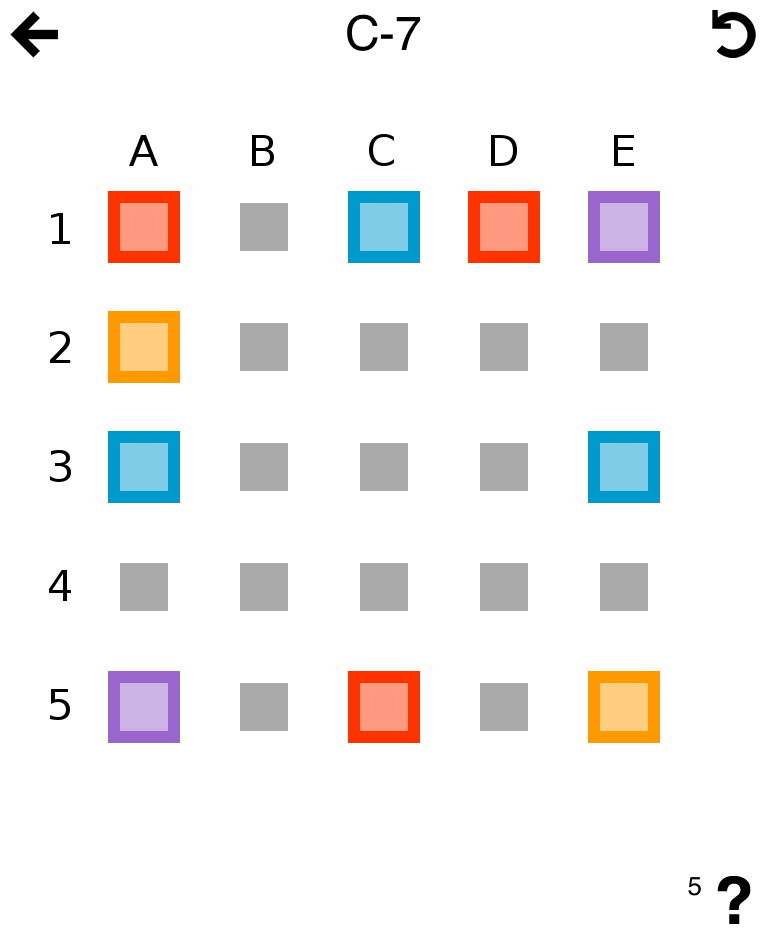
So let's take a look at the above puzzle, where I added coordinates along the edge to make it easier to explain.

The first thing we want to do in any Cross Blocks puzzle is count how many squares there are of each color. When there is an odd number of squares of one color, it means that three of them must be removed at the same time, which limits what we can do with them.

In the puzzle above there are:
3 blue
4 orange
5 red
5 violet

Since there are only 3 blue, there is only one way to remove them: tapping C3. Before being able to do that, we must remove a violet, an orange and a red square.

Let's look at the violets. There are 5, so we have to make one move to remove three of them. Such a move requires two of the squares to be on the same row or colum, so there are two options: E1+E4+C2 and C4+E4+C2.
E1+E4+C2 would require to remove a blue square first. But C2 is one of the squares that prevent that square to be removed, so this move is impossible.
We have to do C4+E4+C2 then, which requires removing two orange squares. It's easy to see that we cannot use the orange square in A2, because it's blocked by the violet in C2 and the blue in A3. Therefore the only way to remove the two orange squares is together, by tapping on C4.
Now we can remove the three violets by tapping on C4 again.
Let's look at the five red squares now. We again have two options for the three-piece move: A1+D1+C5, and A1+A4+D3. Both of them are blocked by a blue square, so we must get rid of the blues first. This is prevented by the red in D3, which implies that we must remove that piece with a two-piece move, so the three-piece move left is A1+D1+C5. The other red square left is A4, so the move we should do now is D3+A4, by tapping on D4.
We can finally remove the blue squares:
Then the red squares:
And now it's trivial to finish.

As I was writing this post, Google+ Auto Awesome thought it was so cool that it collated the images into an animated gif and sent it to me, so I guess I can paste it here :-)


©2013 Nicola Salmoria. Unauthorized use and/or duplication without express and written permission is strictly prohibited. Excerpts and links may be used, provided that full and clear credit is given to Nicola Salmoria and nontrivialgames.blogspot.com with appropriate and specific direction to the original content.

Zen Garden Puzzle: First gameplay video!

Zen Garden Puzzle has been approved by Apple and will be available on the App Store from December 12th!
To whet your appetite, I have prepared a first video to show the game mechanics and interface.


I will talk more about the mechanics in future posts. The one thing I'd like to point out in this video is that the music being played while you drag around the stones is procedurally generated, and different every time you play. I am pleased by the end result. What do you think?


©2013 Nicola Salmoria. Unauthorized use and/or duplication without express and written permission is strictly prohibited. Excerpts and links may be used, provided that full and clear credit is given to Nicola Salmoria and nontrivialgames.blogspot.com with appropriate and specific direction to the original content.

Review: Cross Blocks for iPhone and iPad

Cross Blocks is such a brilliant logic puzzle that I wondered if it had been copied from somewhere else. The developer, Adrenaline Punch Games, had only released word/trivia games before, so a pure logic puzzle like this one is a major shift in focus.
Probably some inspiration for the user interface came from SEQ, but that's all. The mechanics are radically different, and appear to be completely original.

The play area is a board containing some grey and colored squares. Your goal is to remove all the colored squares; you do so by tapping on the grey squares.
When you tap a grey square, its connections in the four main directions are checked. If there are at least two squares of the same color, they are removed.
So in the example above, tapping the grey square at the top would remove the two yellow squares. Tapping the one at the bottom would remove two of the red squares.

But note that there are three red squares in this puzzle, so if you remove two of them you will never be able to remove the single one left. To solve the puzzle, you need to remove all three red squares at the same time.

You can remove two pairs of differently colored squares with a single move. For example, in this puzzle if you tap on the grey square on the second row you will remove two yellow and two red squares. Again, this would be a wrong move because you'd leave a single red square.
Also note that you can't remove two squares that are side by side, like the yellow ones in the third row. There has to be at least one grey square inbetween.

There are other ways to get stuck. For example in this puzzle
if you tap the bottom right grey square, you'll remove two red and two blue squares. This still leaves a pair of each in the top two rows, but they are in such a position that you can't remove the red ones without removing the blue ones first, and you can't remove the blue ones without removing the red ones first.

Logic helps a lot in finding a solution to the puzzles. While some amount of trial and error is probably needed, as it often happens in this kind of games it's useful to think backwards: "I can't remove these pieces until I remove this one, but to remove this one I first need to remove this other one..." From this you get a rough order of removal and just need to fill in the gaps.

If you make a mistake there's an undo button but not a restart button, so to get back to the beginning you need to tap undo multiple times. This is a bit odd but I guess it's ok since you can't make that many moves, even in the larger puzzles.

The game currently contains 120 puzzles, split across 6 worlds of 20 puzzles each. The first 9 puzzles of world A act as a very well thought out tutorial, which seamlessly introduces the rules of the game.
The first two worlds are free, the others can be unlocked through separated in-app purchases, or with a single one to unlock all worlds at a discount.

The puzzles get larger as the worlds progress, with the largest ones being 8x8:
There's also an odd shaped one, but it seems to be an isolated instance all the others I've seen are square.

Very annoyingly, even buying all the worlds doesn't remove the ad banners. This is my number one complaint.

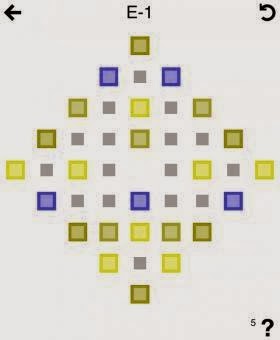
Also, it looks like color blindness hasn't bee taken into account. For example here is a simulation of how a person with protanopia would see the diamond shaped puzzle above:
With its novel mechanics and smooth interface, this is absolutely one of the best puzzle games of 2013. Get it now.


Summary

Nontrivialness★★★☆☆
Logical Reasoning★★★★☆
User Interface★★★★☆
Presentation★★★★☆
Loading Time★★★★★
Saves Partial Progress✘
Status Bar✘

©2013 Nicola Salmoria. Unauthorized use and/or duplication without express and written permission is strictly prohibited. Excerpts and links may be used, provided that full and clear credit is given to Nicola Salmoria and nontrivialgames.blogspot.com with appropriate and specific direction to the original content.

Review: Move: A Brain Shifting Game for iPhone and iPad

I had high hopes in Move: A Brain Shifting Game by the Israelian Nitako.
Initially, the game seemed very fun and addictive. I played through the first 40 puzzles without even realising it. As I moved through the puzzles, however, I felt something was wrong.

But first, let's see the rules. The mechanics are the same as Escapology, stripped to the bare bones by removing the additional clutter of arrows and magnets. Therefore, all we have is a board with some discs, which can move, and gray blocks, which don't move.
When you swipe over the board, all discs that aren't blocked move in the same direction. The goal is to bring all pawns over the colored squares. In the example above, there is only one color, but there can be as many as the number of discs.

The puzzles are divided into packs of 100 puzzles each. The first three packs are free; for the others, you can try the first 10 puzzles and have to buy the rest.

Looking at the pack list, my opinion is that they have been assembled with too strict rules. Every pack contains puzzles of only one kind, e.g. "4x4 board, 4 pawns, 2 colors", which makes them quite boring. Instead of making 12 packs of identical puzzles to cover all combinations, it might have made more sense to provide less packs, with a mix of puzzle types in each pack.
The choice of puzzles is indeed the major flaw of this game. After playing for a while, it becomes obvious that the puzzles have been randomly generated and roughly sorted by the optimal number of moves needed to solve them, but without any attention to their quality or variety. Especially playing the 3x3 puzzles, a feeling of deja vu soon arises. And indeed, look at these two almost consecutive puzzles:
They are identical, except for a reflection.

But the best example in the whole game is this one:
This is the 24th puzzle in its pack. Could it be any more trivial than this?

The game is free and the mechanics are fine so give it a try, but given the poor quality of the puzzle selection I can't recommend spending money on the additional packs.


Summary

Nontrivialness★★☆☆☆
Logical Reasoning★★★☆☆
User Interface★★★★☆
Presentation★★★☆☆
Loading Time★★☆☆☆
Saves Partial Progress✘
Status Bar✘

©2013 Nicola Salmoria. Unauthorized use and/or duplication without express and written permission is strictly prohibited. Excerpts and links may be used, provided that full and clear credit is given to Nicola Salmoria and nontrivialgames.blogspot.com with appropriate and specific direction to the original content.
 
Support : Creating Website | Johny Template | Mas Template
Copyright © 2013. IOS Puzzle Games Review - All Rights Reserved
Template Created by Creating Website Published by Mas Template
Proudly powered by Blogger