Recent Games

Review: The Mansion: A Puzzle of Rooms for iPhone and iPad

In 2006, a group of students of the Sungkyunkwan University, lead by Kim Jonghwa, developed an original game called Rooms. It can be played online on JayIsGames.
Later it became Rooms: The Main Building and was ported to several systems, but the iOS version is no longer available.
A sequel has now been released, called The Mansion: A Puzzle of Rooms, sharing the game mechanics, but with a completely different setting.
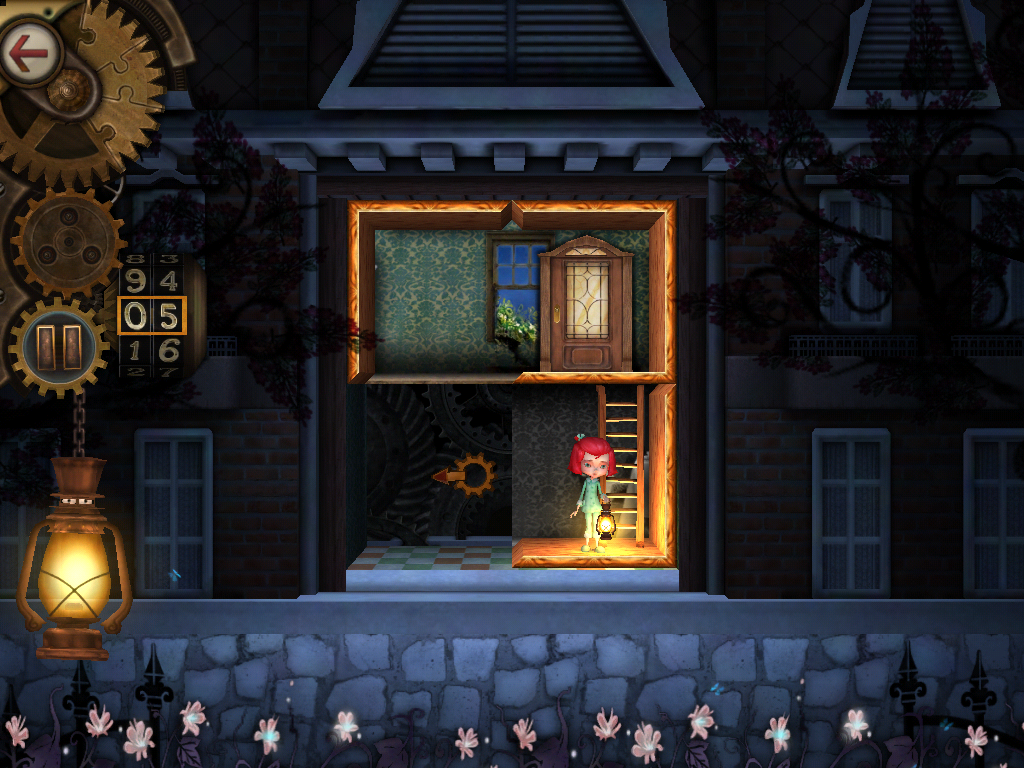
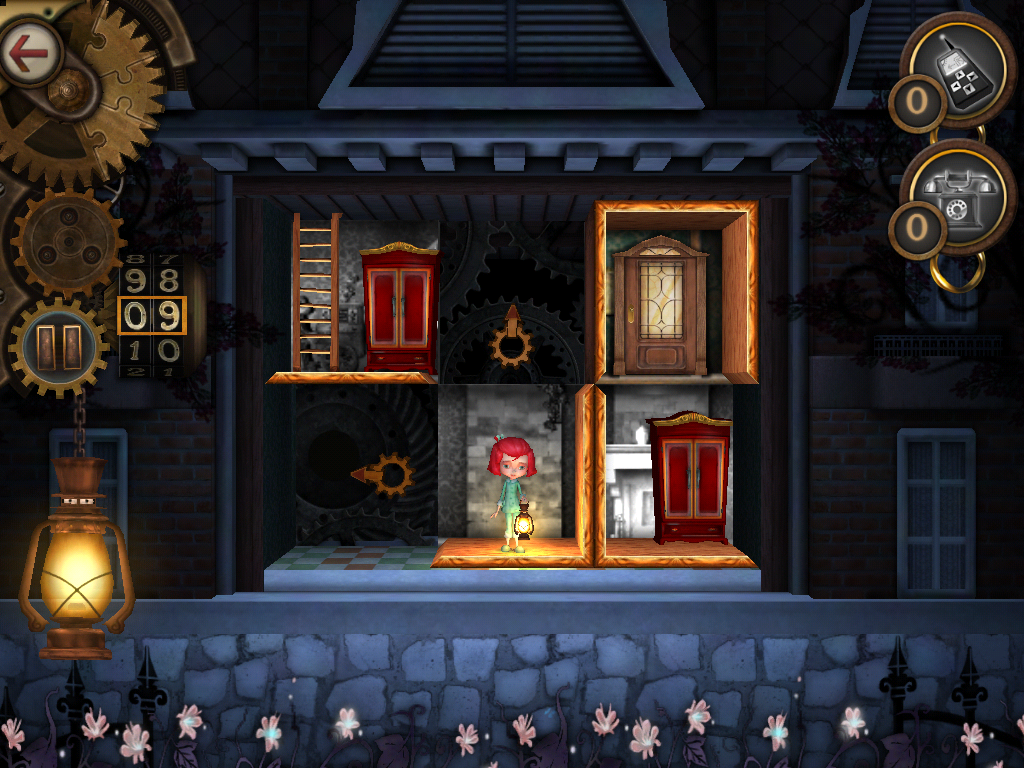
You control a girl, visiting a magical house: its rooms can move. Your goal in every puzzle is to reach the exit.
I find it interesting that the puzzle mechanics are essentially the mirror version of Temple Trap, which I reviewed a few days ago. They are both sliding tile mazes, but while in Temple Trap you can move all tiles except the one where your character is, in The Mansion you can move only the tile where your character is.

Being able to move only one tile is very limiting; it wouldn't be possible to make good puzzles with that alone. Therefore, the game needs to introduce several gadgets to make the puzzles interesting enough. They include:

a telephone, which teleports the girl to another room;
a magic closet, which swaps the two rooms containing the closet, leaving the girl where she is;
bomb boxes, which destroy wooden walls. You need to activate them, then leave the room before they explode;
a magnet, which moves rooms on the same row/column;

and certainly others that I haven't seen yet (I only played the first half of the game so far).

Additionally, some of the puzzles also feature a puppet, which you need to avoid. The puppet moves around in a way which isn't clear at the beginning: later it is explained that it repeats the moves that you make.

The game is clearly targeted at a wide audience, so the puzzles are not too difficult, but they are enjoyable and thanks to the variety of gadgets they don't feel repetitive.

The playing experience is more that of a console game than a mobile game, with all the goods and bads. The presentation is good, it also includes many cutscenes to drive a background story, but the game feels heavy. From the moment you tap the icon, it takes more than 1 minute to actually start playing. You have to go through loading screens, splash screens, animations, player profile selection, and other screens until you can finally resume your previous game. This is the total opposite of the snappy mobile experience we are getting used to.

Also, while playing, the game's pace is a bit too deliberate, with animations delaying every action. It's ok, but it can become annoying when you have to replay a puzzle a few times to find the right solution.

Which raises an interesting point. This is a freemium game, so you can play it for free, but it will try to sell you all kinds of things. One of those things is the ability to replay levels many times. You have five keys, and every time you open a door to play a puzzle you use one of those keys. When you solve a puzzle, you get a key back. Otherwise, it takes 30 minutes for the key to recharge. If you use all keys, you have the option of spending coins to buy new ones, or you need to quit the game and come back later.

Now, this isn't the first game to feature this kind of timers, but it's something that has always struck me as odd. If I designed a game, I'd do everything I could to keep people playing it. The last thing I'd want to do is force them to stop playing. If you want to make people pay for the privilege of playing, you'd better be extremely good and give some motivation to play right now rather then tomorrow. I guess some games have that quality, but I doubt that The Mansion is one of them.
To be honest, the puzzles are easy enough that I never hit the 5 retries limit in my play sessions, so this isn't a big deal.

The other way the game has to sell things is by allowing to buy power-ups that make the puzzles easier. This would be fair enough, provided that you could get a perfect score in the puzzles without having to buy power-ups. Unfortunately this didn't happen in the initially released version, where a few puzzles required power-ups to get three stars. This has supposedly been fixed in version 1.0.5, though I'm not sure since I still have to find a working solution for level 2-11 :-)

There's a total of 72 puzzles, split across three mansions of 24 puzzles each, with more promised to come. In the first version of the game, getting three stars in all puzzles in a mansion would unlock the next one for free; this has apparently been changed now, so that you always have to pay to unlock more levels. That's perfectly logical and not a reason to complain.

I couldn't get the game to run on a 4th gen iPod: it always ran out of memory and crashed. It works better on an iPad mini, but it crashes often on that one too, to the point that I got tired of launching it again and again to take screenshots for this review.

The puzzles are nice, the presentation is very good, the freemium model we can live with, but the long delays and frequent crashes detract from the enjoyment. Anyway, what you get for free is undoubtedly a lot, so give it a try.


Summary

Nontrivialness★★★☆☆
Logical Reasoning★★★★☆
User Interface★★☆☆☆
Presentation★★★★☆
Loading Time★☆☆☆☆
Saves Partial Progress✘
Status Bar✘

©2013 Nicola Salmoria. Unauthorized use and/or duplication without express and written permission is strictly prohibited. Excerpts and links may be used, provided that full and clear credit is given to Nicola Salmoria and nontrivialgames.blogspot.com with appropriate and specific direction to the original content.

Review: Circles: Rotate the Rings, Slide the Sectors, Combine the Colors for iPhone and iPad

The first release of Circles was quite boring. From the screenshots it seemed something different, but in reality it was just another impersonation of the ubiquitous toroidal sliding block puzzle. The only difference was that instead of the usual square grid, in this game the tiles are warped to form a circle.
Luckily, version 1.1 fixed this by adding several new configurations that are guaranteed to make even experts of sliding block puzzles scratch their head.

Review: Temple Trap for iPhone and iPad

Temple Trap (also free) by SmartGames is a port of the physical puzzle by the same name.
I have already talked about the inventor of this puzzle, the Belgian Raf Peeters, in my review of Roadblock.
It is a sliding tile puzzle, with the additional twist that the tiles also form a maze, that your character needs to navigate through. If it were just that, it wouldn't be very interesting, but there's a lot more.

The playing area is a 3x3 grid. The distinctive feature is that the maze is on two floors. Some tiles have stairs, which you need to use to move from one floor to the other. The exit is always on the top left, on the top floor.
The one pictured above is one of the introductory puzzles, which is easily solved by just rearranging the position of the tiles, like this:
In general, however, there is an additional, crucial, rule that makes the puzzles a lor more interesting than that: you cannot move the tile that the explorer is standing on.

Controls are pretty simple: drag a tile to move it; tap on a tile to make the explorer walk to it (if there is a path to get there). One quirk that confused me initially is that, even if the explorer can walk on the top floor tiles, you cannot tap on them to make him go there. That's because there is actually a second additional rule: the explorer cannot stand on a top floor tile while you move the other tiles. So you can only tap on the bottom floor tiles.

I would have liked the walking animation to be a little bit faster, because it can get a bit tiring having to wait for the explorer before being able to make the next move. Additionally, if you make a mistake you cannot make the explorer go back immediately: you still have to wait for him to reach the original destination before making him go somewhere else.

The game contains 110 puzzles, split across 4 difficulty levels. Each difficulty has a different theme: the easiest puzzles have a jungle/crocodile theme, matching the physical game, the others go from a tomb in the desert
to a volcano
to high towers in the sky.
To be honest, I liked the jungle theme best, and I wouldn't have complained if it were used across the whole game.

One detail that annoyed me is a graphical imperfection during the transition from one puzzle to the next. The tiles become half transparent and you can see through them, which is odd and distracting.

After you solve a puzzle, you get a star rating which seems to depend only on the time taken and not on the number of moves. This is not particularly interesting, but it makes no harm since the stars aren't needed for anything. The one thing that is harmful, however, is the timed puzzles that have been forcibly added to the game. Every 10 puzzles, there's one that you must solve within a limited time. You can use coins collected in previous puzzles to increment the time.
This might not be the end of the world for the easier puzzles, but when you get to the hardest ones...
Come on, 30 seconds to solve a puzzle that requires at least 189 moves? You can buy additional time using coins that can be collected in other puzzles, but all in all this seems rather pointless. Thankfully, you can play the puzzles in any order, so you can just skip the timed ones if necessary.

I find it fascinating that a small 3x3 grid, thanks to the ingenious rules, can produce very challenging puzzles requiring up to almost 200 moves. That's way above the capabilities (and patience) of most people, but luckily there's a good number of puzzles at an intermediate level.

Solving the puzzles is an interesting process. Raf Peeters summarizes it well on his site:
Just like any other sliding puzzle, it's not that hard if you understand how a sliding puzzle works (but most people don't). The difference with other sliding puzzles is that harder challenges need to be solved in steps. Although you can use logic to find out what the end position of a challenge could be and it is not so difficult to slide the puzzle piece to to match this position, it can be very hard to get the pawn on the right place at the right time.
A word of warning: I couldn't get the game to run on a 4th gen iPod. It kept running out of memory and crashing. It works fine on an iPad Mini. So get the free version first, to make sure it runs on your device. The free version isn't particularly good at showing the qualities of the game, because it contains 10 of the easiest puzzles, which are just too easy, and then just one puzzle for each of the other difficulties. Still, it should be enough to understand if you like the mechanics.


Summary

Nontrivialness★★★★☆
Logical Reasoning★★★★☆
User Interface★★★☆☆
Presentation★★★☆☆
Loading Time★★☆☆☆
Saves Partial Progress✘
Status Bar✘


©2013 Nicola Salmoria. Unauthorized use and/or duplication without express and written permission is strictly prohibited. Excerpts and links may be used, provided that full and clear credit is given to Nicola Salmoria and nontrivialgames.blogspot.com with appropriate and specific direction to the original content. 


Review: Disctrail for iPhone and iPad

Disctrail by the Swedish Knappra AB is an interactive version of a lesser-known traditional Japanese puzzle called Goishi Hiroi or Hiroimono.

Compared to most of the puzzle games available on the App Store, Goishi Hiroi is fiercely unintuitive, and it had me stumped initially. It took a lot of practice to make it finally click and be able to solve the puzzle without feeling I was moving at random.
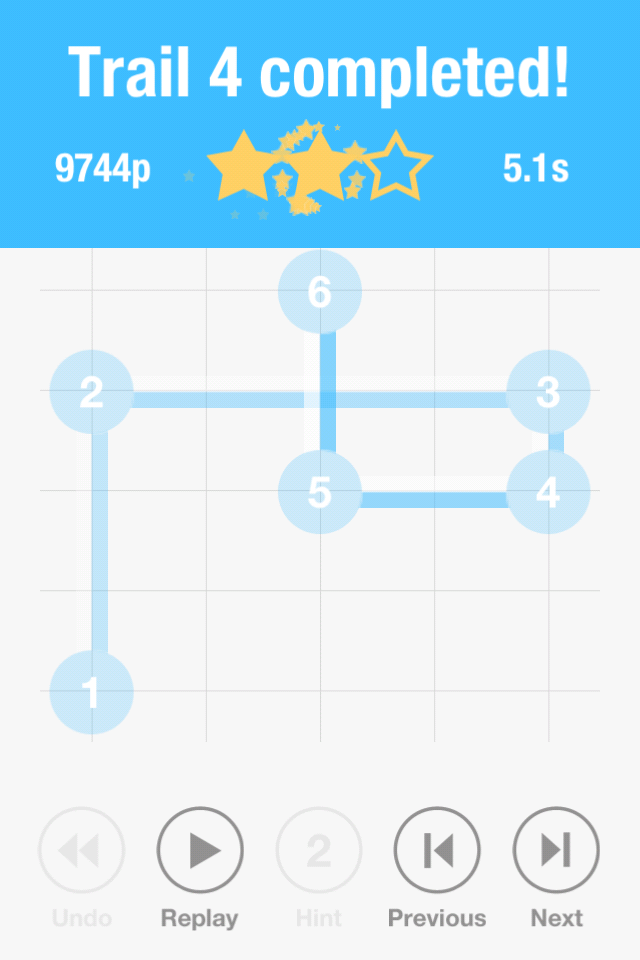
The basic rule of the puzzle is: find a continuous path that connects all the discs. At every step, you can move to the closest available disc in one of the four main directions, but you can't go back in the direction where you came from.

The first uncommon thing is that the path can intersect itself, like this:
Where things get really interesting is what happens when you pass over the same disc twice.

The traditional Goishi Hiroi would be played by putting stones on a Go board and picking them up in sequence, so by the time you'd pass again over the same spot, the stone would no longer be there.
This means that a disc can be the endpoint of a path segment only the first time you pass over it; the following times you can only pass over it as if it wasn't there, so there needs to be another disc on the opposite side.
One thing that I missed initially is that you don't need to tap each disc to create the path: you can simply draw it swiping your finger, which feels more intuitive. If you make a mistake, you can also wind back in the same way.

And many mistakes you will make. The intersections make this puzzle unintuitive, and as the grids get more complicated, the path will cross itself multiple times, making it difficult to picture it out in your head.
Note that because of how the intersections work, the solution is in general not reversible. For example in the puzzle above, if you started from the 14 and attempted to follow the path backwards, you'd use all the discs in the right column on the first pass, and would not be able to move back over it after the 11.

I believe most puzzles have a unique solution, though there are some that have multiple ones, like this one.
Deviating from the traditional rules, some puzzles use discs of two colors, which you must alternate between. This is not surprising since Go stones have two colors so it's a natural extension to use both. This blog post suggests the same thing.

In a sense this makes things easier because it reduces possibilities, but it also makes things harder because you may need to take a more tortuous path in order to respect the color rule.
Further deviating from the traditional rules, and departing even from the Go setting, some puzzles use three colors, which you need to cycle through. On the left of the screen is a reminder of the order to follow.
Initially I thought this was a new mode introduced by this game, but then I found the same kind of puzzles on the Danish website kalkulu.dk.
In some puzzles, the game will help you by indicating from which disc the path should start. This happens a bit randomly, i.e. you'll solve several puzzles without this help, and then it will appear again. I would have preferred to see a clear cut, with easy puzzles showing the hint and later ones not showing it.

Most puzzles have a random layout, but some are aestethically pleasing. I liked this one shaped like a torii. I wonder if it might be a traditional Goishi Hiroi layout.
The game comes with 16 free puzzles, then two additional packs of 48 puzzles each, unlockable through in app purchases.

The 16 free puzzles are definitely not enough to get a full taste of the game. After playing all of them, I was still confused by the rules, and finding the solution felt like pure trial and error in some cases. Only after getting about two thirds into the Green pack, I really started to appreciate the solving process.

I haven't found a way to solve all the puzzles by only using strict logic deductions, but logic can be used to exclude many possibilities that wouldn't allow to complete the path. Solving these puzzles is a bit of an art, and there are a few recurring tricks which one should learn with some practice.

The difficulty definitely increases while progressing, and things start to get tricky in the Yellow pack, which makes all the more rewarding to find the solution.

One thing that annoys me and which I don't think fits this kind of game is that after solving a puzzle you are given a stars rating which depends exclusively on the time it took you to find the solution. So if you think your moves carefully to find the solution on the first attempt without making any mistake, you'll invariable score just 1 star, which is a bit unfair.
Want to fix that? Just tap replay and repeat the solution as fast as you can. It becomes just a game of dexterity.

At the time of writing, the Green pack is free, so definitely download this game now and unlock that pack while the offer lasts. If you are confused after the first few puzzles, don't be put off and persevere. You will get it eventually.


Summary

Nontrivialness★★★★☆
Logical Reasoning★★★★☆
User Interface★★★★☆
Presentation★★★★☆
Loading Time★★★★☆
Saves Partial Progress✘
Status Bar✘

©2013 Nicola Salmoria. Unauthorized use and/or duplication without express and written permission is strictly prohibited. Excerpts and links may be used, provided that full and clear credit is given to Nicola Salmoria and nontrivialgames.blogspot.com with appropriate and specific direction to the original content.

Update: Qvoid 1.7.2


The excellent Qvoid has been recently updated, adding two more free bonus packs, for a total of 40 new puzzles.

I've played some of them and they are very nice: small and challenging, just like I like them.
So if you had to remove the game from your device, this is a good time to reinstall it. And of course, if you missed it entirely, wait no more and grab it right now.

©2013 Nicola Salmoria. Unauthorized use and/or duplication without express and written permission is strictly prohibited. Excerpts and links may be used, provided that full and clear credit is given to Nicola Salmoria and nontrivialgames.blogspot.com with appropriate and specific direction to the original content.

Review: Shapes: A Colorful Challenge for iPhone and iPad

Shapes: A Colorful Challenge is not based on an original idea, but I like its simple mechanics. It would greatly benefit from better graphics, however.
You start with an image composed of colored areas, some of which contain one or more balloons. When you tap a balloon, it disappears and transfers its color to the area it sits on. If adjacent areas have the same color, they merge. The goal is to end with the whole shape of a single color.

To solve the puzzles, you need to find the right order to pop the balloons. In the example above, that would be brown, yellow, and green.

You surely can use some logic to find the solution, but I found that instead of thinking too much I just started tapping right away in what I felt was a good order; often I would not solve the puzzle on the first attempt, but could try again in a slightly different order to fix my mistakes.

There's a great variety of shapes and difficulties. Unfortunately the solutions to many puzzles are not unique, and in some cases I was even able to solve a puzzle without using all the balloons. So I don't think the puzzle design has been done with all the care it should have taken.

In terms of mechanics, the only additional element I found is a "swapping" balloon, which is used sporadically.
Here one of the yellow balloons has double arrows around it. When you tap it, instead of disappearing it swaps color with the area it's in. After the first tap, it becomes a normal balloon.

The most annoying thing in this game is that the graphics are very low resolution, as can be seen clearly here:
Since the game obviously has an artsy feeling, I would have liked the images to be high resolution. As they are, they feel like a poke in the eye sometimes.

I also think that the animations during the screen transitions have an excessive amount of bouncing, which makes them feel cheesy.

There's a total of 180 puzzles playable for free; that should be more than enough for most people. There's also two additional packs of 60 puzzles each, purchasable separately. Surely worth a try.


Summary

Nontrivialness★★★☆☆
Logical Reasoning★★★☆☆
User Interface★★☆☆☆
Presentation★★☆☆☆
Loading Time★★★★☆
Saves Partial Progress✘
Status Bar✘

©2013 Nicola Salmoria. Unauthorized use and/or duplication without express and written permission is strictly prohibited. Excerpts and links may be used, provided that full and clear credit is given to Nicola Salmoria and nontrivialgames.blogspot.com with appropriate and specific direction to the original content.

Review: Woven for iPhone and iPad

Woven by Eilean Design was released just a few days after the very similar Strata, but is different enough to deserve its own review.
Interestingly, when Tom Cutrofello reviewed this game on his blog, I commented saying that it is better than Strata because there isn't a mechanical way to solve the puzzles. I couldn't be farther from the truth. More on this later.

The goal in both games is the same: pull colored ribbons over the playing area, in such an order that the color of the top ribbon over each square is a given color. The crucial difference is this: in Strata, you choose the color of the ribbon, and you place it over a whole row/column at once. In Woven, the ribbons have predetermined colors and can be moved one step at a time; also, you can pull ribbons from both sides of each row/column, until they meet in the middle.

For example while solving this puzzle:
you could end up in this position, with an empty cell in the middle waiting to be filled.
The user interface mechanics have been well thought out. At any point, you can undo your moves simply by pulling a ribbon back. When you move it forward again, it will go over the existing ribbons as if it was a new move. This works very well and avoids small errors causing a frustration.

The only awkward thing is that to quit a puzzle you need to bring up a menu by double tapping the screen. This is explained in the tutorial, but easily forgotten.

There also appears to be a bug with the finger tracking, because dragging a ribbon across the whole screen doesn't work properly: the ribbon lags behind, moving slower than the finger, so you need two swipes to complete the move. Hopefully this will be fixed in a future update.

There's about 200 puzzles included in the game, about half of which are free. The sizes vary; larger puzzles look like this:
They might look intimidating at first glance, but as I said at the beginning, there is a mechanical way to approach them.

SPOILER ALERT don't read past this line if you want to solve the puzzles yourself.


Since you can move one step at a time, the way to solve these puzzles is to literally weave your way through them, one cell at a time, starting from the corners and going towards the center.
For example let's take this puzzle:
What you need to do is find a corner where at least one of the neighboring ribbons matches the color of the dot. Drag both ribbons over the cell in the appropriate corner, and continue. For example in this case we can start form the top left corner:
If all ribbons bordering a cell are the wrong color, it means you'll have to reach that cell from the opposite side: leave it for later and go to another corner. In many cases, this is all you have to do to solve the puzzle. Occasionally, you could reach a position where the strategy can't be applied, and a little more thought is required, like this one:
But in general you should easily run through the puzzles with no particular problems.

As trivial as that may be, I found the solving process relaxing. This is the kind of puzzles that you can solve semi-mechanically, while thinking about something else. Don't approach this game expecting a challenge, but definitely give it a try: it's free anyway.


Summary

Nontrivialness★☆☆☆☆
Logical Reasoning★☆☆☆☆
User Interface★★★☆☆
Presentation★★☆☆☆
Loading Time★★☆☆☆
Saves Partial Progress✔
Status Bar✘

©2013 Nicola Salmoria. Unauthorized use and/or duplication without express and written permission is strictly prohibited. Excerpts and links may be used, provided that full and clear credit is given to Nicola Salmoria and nontrivialgames.blogspot.com with appropriate and specific direction to the original content.

New blog about puzzles


Glenn A. Iba, mathematician and author of the excellent Monorail, recently started writing a blog where he talks about himself and logic puzzle design. If you are curious about the minds that create the games we love, go take a look.

©2013 Nicola Salmoria. Unauthorized use and/or duplication without express and written permission is strictly prohibited. Excerpts and links may be used, provided that full and clear credit is given to Nicola Salmoria and nontrivialgames.blogspot.com with appropriate and specific direction to the original content.
 
Support : Creating Website | Johny Template | Mas Template
Copyright © 2013. IOS Puzzle Games Review - All Rights Reserved
Template Created by Creating Website Published by Mas Template
Proudly powered by Blogger